Becomes three dimensional
The rooftop stops being a laundry line and becomes parking and runway. Real estate value starts being measured upward too.
 Es Posible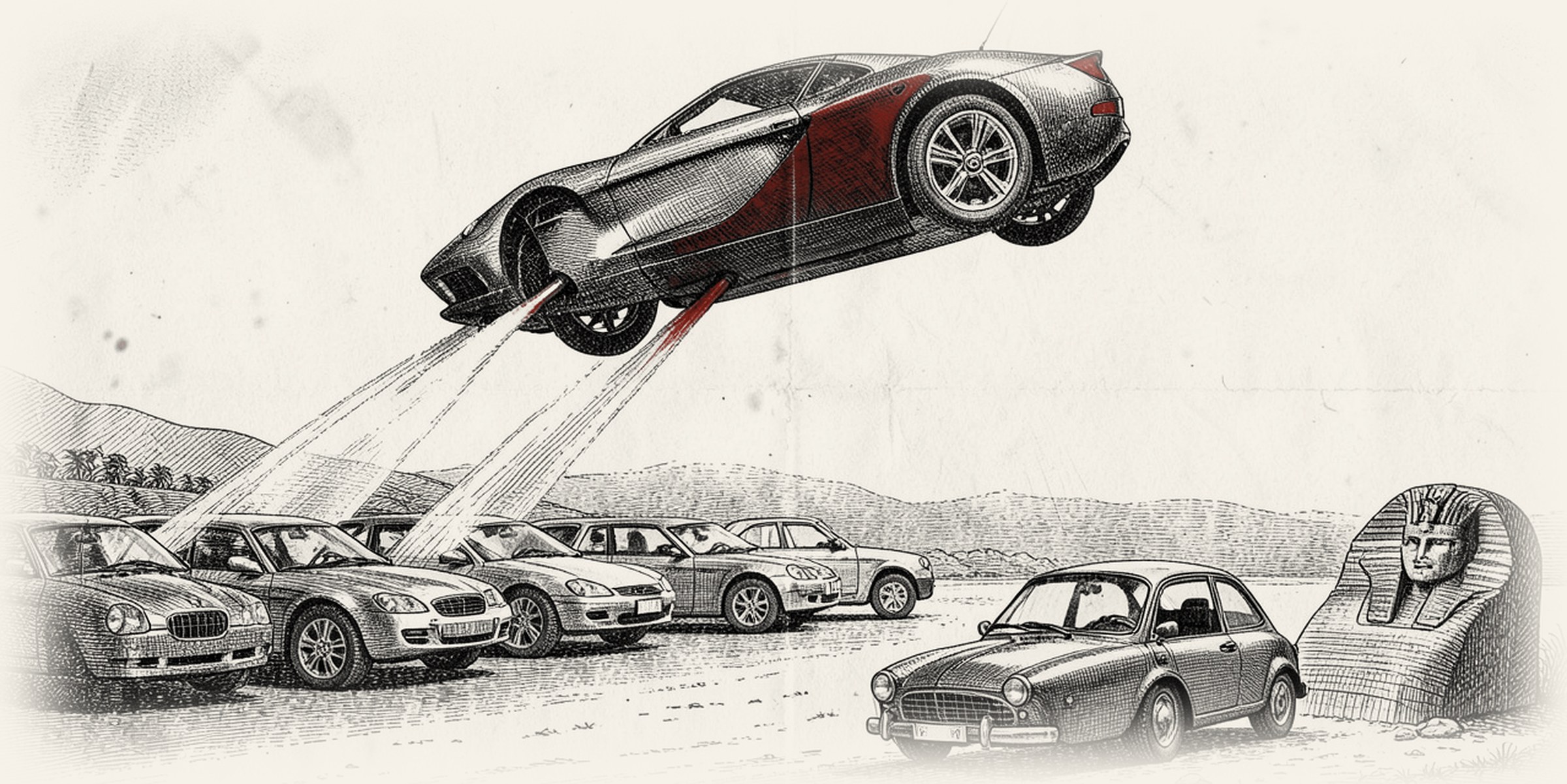
On Thursday a car hopped over five others in Texas. In Puebla, the government’s car is slower than the 1908 Ford Model T.
How a car flies, explained without formulas. How Mexico went back seventy years in seven. Who will buy the first flying car in Mexico. And where the money is for Mexicans in a race that has already started.
A flying car hopped over five cars in Texas yesterday.
In 1962, The Jetsons imagined flying cars for 2062.
They arrived 36 years early. In Texas, not in Puebla.
In Puebla, the Mexican government’s car is still not for sale and is slower than the one from 1908.
That is not a gap in money. It is a gap in country.
And it is not Latin America’s fate. In Brazil, Embraer has already flown its electric air taxi and wants to deliver it in 2027, the same year Mexico promises a 50 km/h car.
And that is not the harshest comparison. The harshest is against a car from 118 years ago.
On Thursday, October 15, outside Waco, Texas, Tesla unveiled its new Roadster.
It drove up an inverted ramp, spun in the air and landed softly on the pavement. While moving, it used thrusters to hop over a Cybercab, a Cybertruck, a Semi, a Model Y and a Model 3. Elon Musk called it “the best of the last of the human-driven cars.” Production starts in 2028.
That same Thursday, in Mexico, the government’s car was still a promise. It is called Olinia. It was announced on October 2, 2024, one day after the inauguration. It was presented on June 7, 2026. It costs 150,000 pesos. Its top speed is 50 kilometers per hour. First deliveries are promised for summer 2027.
Today you cannot buy it. It is not in series production. And, by its own spec sheet, it is slower than the 1908 Ford Model T, which reached 72 kilometers per hour.
Hence the title: you so Olinia, the world so Tesla. In Spanish it sounds like Tutankhamun, and that is no accident: it is a car born a mummy.
First, what it is not: it is not an airplane. It has no wings or rotors to hold it up. What it does is closer to a controlled jump.
There are two systems, and both can be understood with things you have at home.
One: the vacuum cleaner. Fans under the car pull out the air beneath it. With less air below than above, the air on top presses the car into the ground. Tesla says that, standing still, the system produces up to 2G: a downward force twice the car’s own weight. That is what lets it stick to the asphalt in an impossible corner and, in theory, drive on a wall. It is not new: the British McMurtry Spéirling already does it.
Two: the fire extinguisher. This is the part that flies. The car carries compressed air, 600 liters according to Tesla’s vice president of engineering, Lars Moravy, stored in carbon fiber wrapped tanks of the same family SpaceX uses in its rockets. That air rushes out through ten nozzles around the car.
It is Newton’s third law, the balloon you let go without tying: if the jet pushes down harder than the car weighs, the car rises. If it pushes sideways, the car spins. It is called cold gas because nothing burns: no explosion, only pressure.
I did the math. Assume the car at 1,814 kilos, the 4,000 pounds reported by reviewer Marques Brownlee, not by Tesla. Assume the 600 liters at 300 bar: about 198 kilos of air, exiting at 500 meters per second. Holding it in the air takes about 17,800 newtons of thrust, which burns 36 kilos of air per second.
The tank empties in about five and a half seconds. Seconds, not minutes. That is why it is a hop, not a flight. Move the numbers yourself.
Assumptions: air at 15 °C with an approximate real gas correction; thrust equals weight (hover without rising or falling). Tesla has not published pressure or airtime: this is a physics illustration, not company data.
“It sounds like Tutankhamun for a reason: it is a car born a mummy.Chapter 01
These are the company’s numbers. None has been independently verified, and the last row is the most honest of all.
| Item | What Tesla announced |
|---|---|
| 0 to 60 mph | 0.59 seconds on the Rocket trim, per Tesla. Own calculation: 4.6 times gravity pushing you into the seat. |
| Range | Over 300 miles (480 kilometers). |
| Top speed | Over 230 mph (370 km/h) on the Rocket trim. |
| Thrusters | Ten cold gas thrusters on the Rocket trim, developed with SpaceX: forward and upward acceleration plus lateral rotation. |
| Grip | Multi-mode suction of up to 2G at a standstill and active aero. |
| Steering | Steer-by-wire: the wheel is no longer tied to the tires by steel, but by software. |
| Materials | Magnesium, titanium and carbon fiber. |
| Price and date | 50,000 dollar reservation for Performance and 250,000 for Thrust. Rocket is invite only. Production from 2028. |
| Musk, unfiltered | He said safety “is not the main goal” and that Tesla will “aspire not to kill anyone in this car.” |
Each lane moves in proportion to each car’s top speed, flat out for one minute. Sources: Olinia spec sheet via Expansión; Ford Motor Company; Expansión, October 15, 2026; Tesla.
The same day it was reported that a Chinese microcar, the Jinpeng UNI, is arriving to compete in Mexico: four seats, 100 km/h, up to 200 km of range, from 215,000 pesos, with ABS brakes and a rear camera. Olinia is not out yet and it already has a Chinese rival that goes twice as fast.
This is not an engineering problem. Mexico’s Polytechnic and its national technology institutes have talent to spare.
It is a problem of national vision: a government that sets out to build a car instead of creating the conditions for Mexicans to build the car.Simón Levy
Seven years of government. Seventy-four years of rewind.
Diesel Nacional, DINA, was born in 1951 as a federal government company and even assembled Fiat cars. It was sold to private owners in 1989. Olinia, announced in 2024, is the same model under another name. The last new refinery had opened in 1979; Dos Bocas, in 2022. Pemex produced 1.635 million barrels a day of liquids in 2025, the lowest since 1990. Mexicana came back in December 2023 run by the Defense ministry. And on October 14 a Mexico City bank was announced with no capital, no rules and no date.
Drag the timeline →
The federal government creates Diesel Nacional. It even assembles Fiat cars.
Salina Cruz and Cadereyta: the last new refineries for 42 years.
The state stops building vehicles. Mexicana also goes private.
First comparable year of Pemex liquids output.
A government begins that puts the state back to building, refining, flying and lending.
The state refines again: the first new refinery since 1979.
In December it comes back as an airline run by the Defense ministry.
October 2: one day after the inauguration.
1.635 million barrels a day of liquids: the lowest since 1990.
October 14: a Mexico City bank with no capital or rules. October 15: the Roadster hops in Texas.
That is third-worldism: it is not poverty, it is a choice. Populism does not invent the future. It promises it, administers it and cuts the ribbon. A state that wants to build cars, refine oil, fly planes and lend money, all at once, has neither the time nor the money for the one thing that is its job: letting Mexican talent invent.
“In seven years we went back seventy.Chapter 05
Mexico built 3.95 million vehicles in 2025 and exported 3.38 million, according to INEGI. It is an auto powerhouse without a single homegrown brand at scale.
The whole country obtained 972 patents for Mexican inventors in 2025. IMPI celebrated it as a record since 1995. That 972 is a record is the data point. Not the consolation.
The first car to hop over traffic in a Mexican city will not be designed by a Polytechnic engineer. It will be bought by a narco-politician.
With the money that should have paid for labs, scholarships and patents. Instead of Mexican minds creating the flying car, we will have Mexican accounts buying it.
And there is the trap for them. A Roadster is bought in the United States. A cash payment of more than 10,000 dollars requires the seller to report it to the IRS and FinCEN on Form 8300, under 26 U.S.C. 6050I. And spending more than 10,000 dollars of criminally derived money in a single transaction is a federal crime on its own, under 18 U.S.C. 1957.
“The toy that flies leaves a trail on the ground.Chapter 07
Tesla beat China in the race. But China will mass-produce it and make the same thing at lower cost.
It is already getting ready: XPeng’s flying car unit, now called Aridge, is aiming to deliver its flying car in 2027. In October 2023 China certified EHang’s EH216-S, the world’s first pilotless passenger aircraft with a type certificate. And Joby, in the United States, is in the final stage of FAA certification, with a launch planned in Dubai.
You already saw the pattern with the Jinpeng UNI: the government promises a 50 km/h car for 2027 and China already sells one at 100 km/h. What the United States invents on a stage in Texas, China puts on a production line. And Mexico decides whether it is the assembly yard of that race or just the market where both are sold.
Latin America is not out of this race. It already has a contender.
In Brazil, Eve, Embraer’s electric air taxi company, flew its full-scale prototype at Gavião Peixoto in late 2025 and aims to certify it and deliver the first units in 2027. That is the same year Mexico promises its 50 km/h car. Two countries in the same region, two ideas of country: one put its industry to compete in the air; the other put the government to build a car.
For Colombia, Chile, Peru, Argentina or Central America the lesson is the same. The region does not need state cars. It needs certified suppliers, clear rules for low airspace and cities ready to receive these vehicles. Whoever gets to those three things first becomes the region’s workshop.
The rooftop stops being a laundry line and becomes parking and runway. Real estate value starts being measured upward too.
Who is liable if a car falls on a house? Who regulates the low air between rooftops and planes? Insurance, aviation law and the license get rewritten.
Organized crime already uses drones. The question for any serious government is not whether these vehicles will arrive, but who will have them first.
Whoever repairs the car that hops is a certified technician. And that technician gets paid in dollars.
Here is the good news, and it is huge: Mexico already has half the factory this race needs.
It exported 10.7 billion dollars in aerospace goods in 2024, according to FEMIA, and is the world’s fourth largest aerospace exporter. About 80% goes to the United States. A car that hops is, in parts, a small airplane. And small airplanes are made with what northern Mexico already knows how to do.
Sources: FEMIA and Banxico via Expansión, March 3, 2026; INEGI. The opportunities are the author’s analysis, not investment advice.
Olinia will do none of this. Mexicans who learn these skills, starting today, will. And the first one is not engineering: it is learning to use artificial intelligence to design, quote, certify and sell. That is what I teach at cursos.simonlevy.mx.
If you are Mexican and wonder what is in the flying car race for you, here is the short answer.
You do not need the government to build a car. You need to know which link of the chain you fit, what you will be asked for and whom to sell to. This is what is there, depending on who you are.
Your market is structural and engine parts, and the special processes big plants subcontract. First step: your capability sheet and AS9100D certification.
Certified maintenance of things that fly is the best paid trade of the decade. First step: aviation maintenance training and electrical specialization.
Safety critical software pays in dollars and can be done from Mexico. First step: ISO 26262 or DO-178C.
Pick one of the seven links and specialize. Plants in Baja California, Sonora, Chihuahua, Querétaro and Nuevo León hire people who know.
You do not have to build the vehicle. Assembly at scale, inspection, logistics, certification and training for those already here.
Volkswagen and Audi invested more than 2 billion dollars in EVs. High voltage harnesses, light stamping and electronics: real purchases, in Olinia’s own state.
The opportunity is not in the government car. It is in the plants already buying in Mexico and the ones about to arrive. So you do not stop at reading, I built five steps, from the simplest to the most complete.
Eight questions. CIES scores your readiness, your gaps and your next step. In Spanish.
Six states: who buys, what they ask for, how it is financed and your 90 day route. With PDF. In Spanish.
Nine modules with artificial intelligence: certifications, buyers, quoting, financing and selling in English. In Spanish.
Written report and a 45 minute session for your company with Simón Levy and his team.
Every month: plants, purchases, certifications and moves by the United States and China. In CIES.
The difference between Waco and Puebla is not money. It is the idea of a country. The United States makes a car hop over five cars and says safety is not the main goal. Mexico makes a car that tops out at 50 km/h and calls it sovereignty.
In seven years we went back seventy. Tesla beat China in the race, and China will mass-produce it at lower cost.
The only question that matters for Mexico is whether we will build that race or just buy it. If we buy it, the narco-politicians will buy it. If we build it, Mexicans will build it.
Roadster specifications are Tesla data and have not been independently verified. The term narco-politician is used as a general category and does not refer to any particular person; no one is accused in this text and everyone retains the presumption of innocence. The opportunities described are not investment advice.